


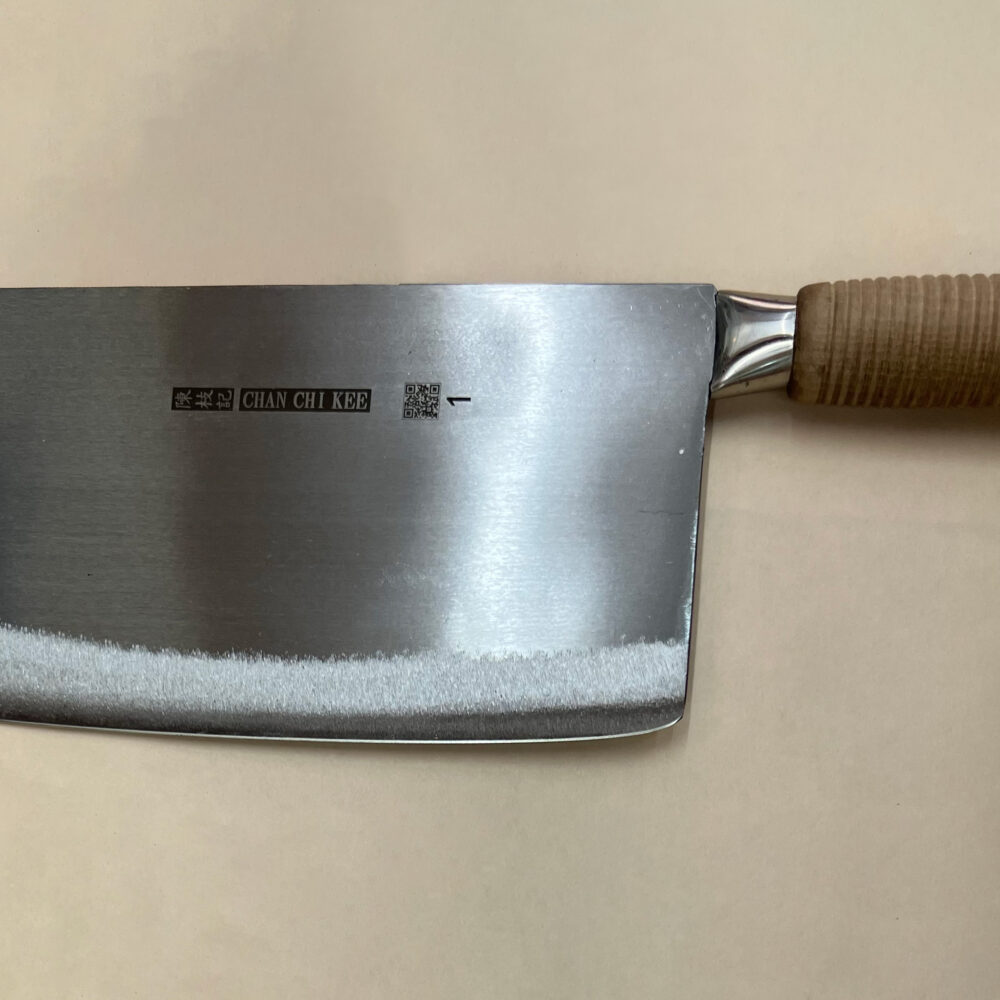
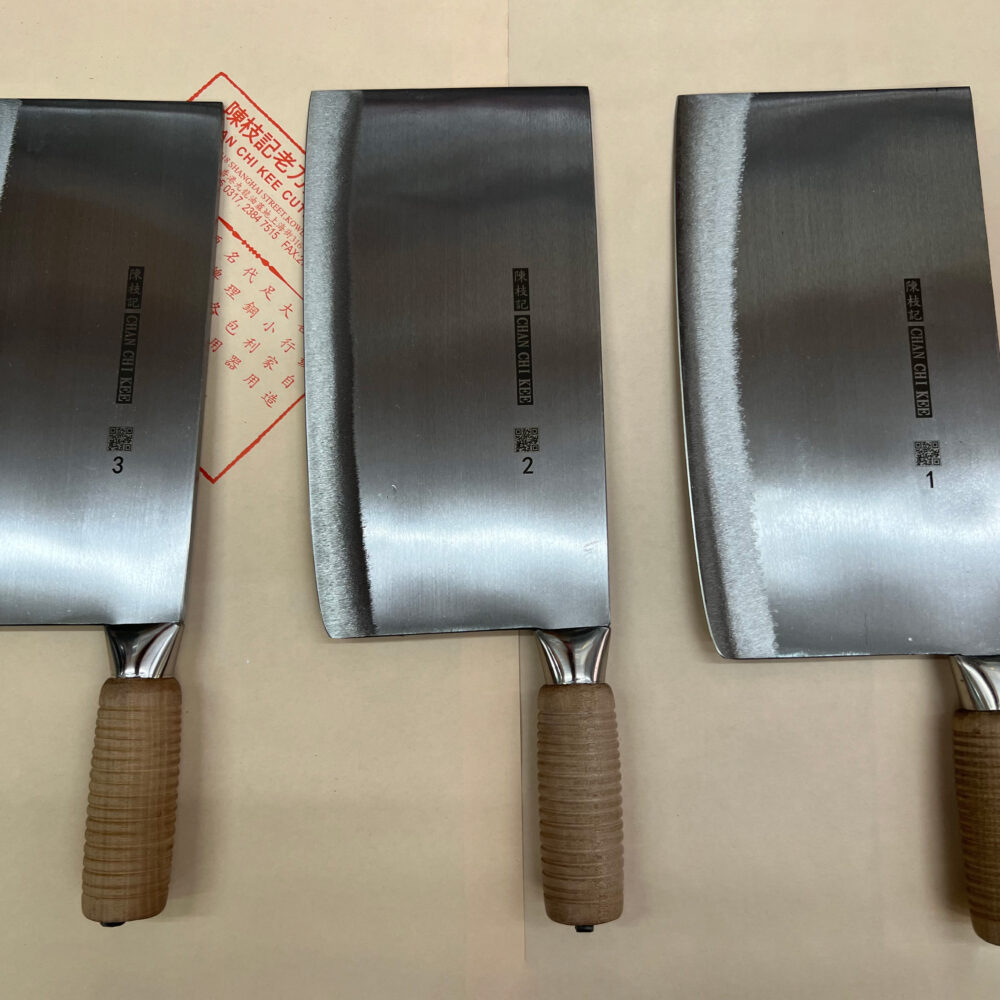
The standard Bone Cleaver is CCK’s 烧臏刀 (shāo là dāo), the BBQ shop cleaver. This is the knife you see hanging in every Cantonese roast meat shop, used to portion roast duck, char siu, and siu yuk into neat pieces straight through the bone. At a Heavy blade profile, it’s a wide blade that relies on mass and a sharp edge to cut cleanly through pork and beef ribs. The blade is tall (12.5–13.5cm) and long (24–25cm), bigger than the Kau Kong, bigger than the All-Purpose Cleaver. This is a specialist tool for bone work.
Most heavy Western meat cleavers are cut from a steel plate. The CCK Bone Cleaver is forged, then expertly sharpened to an ogival edge profile. The cutting geometry is closer to a high-end wood axe than a kitchen knife, with plenty of material behind the edge to drive through bone without chipping or bending. It cuts cleanly through pork ribs and poultry joints rather than smashing through them. That’s the difference between neat, presentable portions and a mess of bone fragments, exactly what roast meat shops need when chopping roast duck or char siu into pieces that look good on the plate. The wide, tall blade also doubles as a scoop for transferring portions.
Handles pork and beef ribs comfortably, the bones you’d encounter in a roast meat shop. For lighter, home-scale bone work, see the Bone Cleaver – Home. For splitting raw bones and serious butchery, see the Restaurant Bone Cleaver (Super Heavy profile). For whole-carcass butchery, look at the Butcher’s range.
Choose carbon steel for the sharpest edge and easiest re-sharpening. It needs drying after use and occasional oiling (see our carbon steel care guide). Choose stainless steel for the low-maintenance option: corrosion-resistant and dishwasher-friendly when paired with the stainless handle. The rustic mulberry wood handle offers great grip even with wet hands; the stainless steel handle is dishwasher-safe when paired with a stainless steel blade. Hand-wash versions with a wooden handle or carbon steel blade.
Sizes
| Blade Material | Handle | Size | SKU | Blade Length | Blade Height |
|---|---|---|---|---|---|
| Carbon Steel | Mulberry Wood | 三號 No.3 (S) | KF1503 | 24 cm | 12.5 cm |
| 二號 No.2 (M) | KF1502 | 24.5 cm | 13 cm | ||
| 大號 No.1 (L) | KF1501 | 25 cm | 13.5 cm | ||
| Stainless Steel | Mulberry Wood | 三號 No.3 (S) | KF1513 | 24 cm | 12.5 cm |
| 二號 No.2 (M) | KF1512 | 24.5 cm | 13 cm | ||
| Stainless Steel | Stainless Steel | 三號 No.3 (S) | KF1523 | 24 cm | 12.5 cm |
| 二號 No.2 (M) | KF1522 | 24.5 cm | 13 cm |
Which size? 二號 No.2 (M) is the all-rounder and what we recommend for most professional kitchens. 三號 No.3 (S) for more compact setups. 大號 No.1 (L) for breaking down large quantities, only available with carbon blade and mulberry wood handle.
A note on the stainless-steel-handle variants (KF1522 / KF1523): the manufacturer labels these with NO.2 and NO.3 swapped relative to the carbon steel version: KF1522 (NO.2) measures 24 × 12.5 cm and KF1523 (NO.3) measures 24.5 × 13 cm. Dimensions are as supplied; the size numbering is the manufacturer’s.
HACCP colour-coded plastic-handled versions are available as separate products.
What others are saying
There are no contributions yet.